Search This Blog

Thursday, 12 June 2014

New How to Rent Guide launched by the Government

Housing Minister Kris Hopkins launches new 'How to rent' guide for private rented sector tenants.
The heat is on for the small minority of rogue landlords as Housing Minister Kris Hopkins launched a new on-the-move guide to give private rented sector tenants the need to know rental rights at their fingertips.
Mr Hopkins said that encouraging a new generation of well-informed tenants with easy access to useful and understandable information would help root out the small minority of rogues and raise the game of any landlords who don’t know what is expected of them.
https://www.gov.uk/government/publications/how-to-rent 

Monday, 9 June 2014

Southampton Property news


Please click on the link below for the Southampton Property Report.

http://downloads2.belvoirlettings.com/Offices/Southampton/Southampton%20Property%20Newsletter.pdf

A landlords view

Rather than bashing buy-to-let landlords, we should help them to flourish

Comment: Landlords should be encouraged to buy – and build – more properties to ease the shortage of housing

Direct Line rent
The vast majority of private renters are happy with their home, with tenant satisfaction levels outpacing those in the social sector
Advertisement
The private rented sector is a great British success story. It’s the fastest-growing part of the housing market, doubling in size over the past 20 years and expected to more than double again over the next two decades. This growth is desperately needed to keep up with the demand for new homes as house prices rise and public investment for social housing is squeezed.
But it’s not just about the housing shortage: renting is a genuinely popular choice. The vast majority of private renters are happy with their home, with tenant satisfaction levels outpacing those in the social sector. And rents are increasing by less than inflation, according to the latest official figures – even in London, where properties are in the greatest demand.
Yet instead of celebrating these successes, there are increasing calls from some for more regulation of the rented sector. Read some of the proposals for compulsory licensing schemes, or for rent controls, and you could be forgiven for thinking that war had been declared on the British landlord.
These populist messages, calling for a crackdown on the private sector and ranging landlords against tenants, are divisive and unhelpful at a time when landlords need more encouragement and support, not less, to provide the new homes the nation so badly needs.
Of course, that’s not to say we don’t need rigorous enforcement for the small number of poor landlords who bring the sector into disrepute. But for the vast majority, already facing layers of regulation built up over years, a more flexible approach, coupled with a level financial playing field, would encourage them to invest in new property and so increase the choice on offer for tenants.
The Government has already recognised the importance of expanding the rented sector. Encouraging more institutional investment, as it wants to do with its £1bn build-to-rent fund and £10bn debt guarantee scheme, is one route.
But it will be just as important to support the 89pc of individual private landlords who control almost three quarters of our private rented stock. Most are only part-time landlords and most have just one property that they rent out – but we know that many of them would like to grow their rental businesses if they could.
If we could encourage just a tiny percentage of this army of small landlords to invest in another home or two, we could provide thousands more homes for tenants who need them.
So what will help them to do that? First, we need a more flexible tax regime, which addresses some of the inequities that mean private landlords are treated less favourably than owner-occupiers and the social housing sector. Measures such as rolling over capital gains tax when sale proceeds are reinvested in a rental home, a fairer treatment of capital expenditure on repairs and improvements and VAT relief on substantial work would all help landlords to invest to improve standards.
They would create a more dynamic market, boost the economy through spending on construction and refurbishment – and bring in more revenue for the Treasury through increased turnover of properties.
We’d also like to see more help for smaller landlords who want to develop newbuild schemes for rent. They could make good use of small plots of public-sector land or empty buildings that wouldn’t appeal to bigger developers, perhaps with the public owner retaining an interest in the land and a covenant ensuring that the new buildings remained as rental properties for at least 10 years.
Councils would not only gain a new-homes bonus but also council tax revenue, and new homes transform eyesores of derelict land. All at no public expense.
And we’d like more flexibility over turning houses into small shared homes. It’s argued that the rules in this area are needed to prevent areas becoming student “ghettos”. Yet in many locations shared houses, ideal for younger professionals and key workers, make an effective use of our housing stock.
We’d urge politicians to turn their back on the calls for rent control and more regulation, both of which would discourage rather than encourage the investment we need. Instead of a populist stampede towards more red tape, we need a streamlined regulatory system that enables effective enforcement where it is really needed.
In that way we will see a sector that increases at a healthy rate, the best way of driving up quality and choice for tenants.
A growing private sector has a key role to play in tackling the housing shortage. Rather than bashing private landlords, we should help them to flourish. That will be good news for tenants and landlords alike.
 Alan Ward is chairman of the Residential Landlords’ Association


http://www.telegraph.co.uk/finance/personalfinance/investing/buy-to-let/10878209/Rather-than-bashing-buy-to-let-landlords-we-should-help-them-to-flourish.html

Friday, 6 June 2014

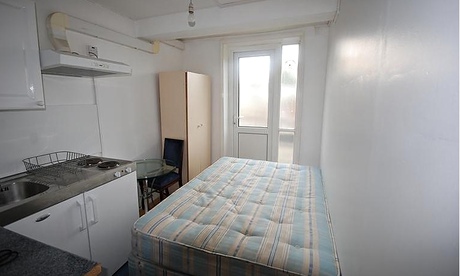
When is a studio flat not a studio - when it's a shoebox!


Shoebox 'studio flat' in London snapped up by renters within 16 hours

Apartment barely big enough for double bed and sink is rented for £170 a week
The scale of London's property boom was highlighted on Tuesday when a shoebox "studio flat" barely big enough to fit a double bed and a sink was snapped up by eager renters less than 16 hours of being advertised, despite costing £170 a week or £737 per calendar month.
Photographs of the flat, on Kember Street close to King's Cross, reveal a small single room into which has been crammed a double mattress, a small glass table and upright chair, a narrow wardrobe and a number of fitted kitchen units.
Despite its compact scale, Stephen Boochon from the estate agents Relocate Me said his firm had received about 20 emails and a larger number of phone calls since the property launched on the rightmove.co.uk website in the early hours of Tuesday. "We had a fair bit of interest, I would say," he said, before the property was let later the same day.
Though no dimensions are included in the advertised details, there appears not to be enough room to fully open the front door or kitchen cupboards, and barely enough space to walk around the bed. Boochon said the property was owned by a local landlord, adding that it had a separate toilet and shower area.
six-bedroom house less than a mile from the studio flat is currently being advertised at £2,300 a week, or £9,967 pcm.

HMO landlord fined for breach of fire safety

Landlord pays the price for fire trap house


Friday 6th June 2014
A landlord in Bury, Great Manchester, has been ordered to pay almost £20,000 for breaching fire safety regulations.
Zohar Khan of Hampton Grove, Bury, was fined £17,000, ordered to pay Greater Manchester Fire & Rescue Service (GMFRS) £2,223 in costs, and a £120 victim surcharge, following a hearing at Bury and Rochdale Magistrates Court on 2 June.
The 45-year-old pleaded guilty to five offences under the Regulatory Reform (Fire Safety) Order 2005 at a house in multiple occupancy on Walmersley Road, Bury.
The court heard there were combustible items in the hall and landings, which would have helped a fire take hold and spread quickly.
There were no fire doors and holes in the ceilings which meant a fire in any part of the property would have quickly spread with smoke and toxic gases blocking the only escape route.
There was no way of warning tenants about a fire as the fire alarm was faulty and switched off and a battery operated smoke detector which had been fitted was in the wrong place and could not be heard in the bedsits.
Abigail Hudson, prosecuting for GMFRS, said: "A fire anywhere would quickly fill the only escape route with smoke. If the electrics failed, the lack of emergency lighting would mean the escape route would be dark and filled with smoke becoming impassable." see full article at
http://www.landlordtoday.co.uk/news_features/Landlord-pays-the-price-for-fire-trap-house

Southampton HMO landlords beware

HMO landlord ordered to pay £39,000


Friday 6th June 2014
A Leicester landlord has been ordered to pay almost £39,000 in fines and costs for failing to obtain licences for three houses in multiple occupancy (HMOs).
Harishbhai Rambhai Patel was prosecuted by Leicester City Council and pleaded guilty to 12 offences under the Housing Act 2004 relating to the three unlicensed houses in the Highfields area of Leicester.
Magistrates fined Patel £10,000 for each of the three houses. He was also fined £500 for failing to produce necessary documents and a further £4,000 for eight breaches of the Management of Houses in Multiple Occupation (England) Regulations 2006.
On top of that magistrates ordered Patel to pay £4,124.15 in legal costs, along with a £120 victim surcharge. In total, he will have to pay £38,744.15.
Environmental health officers from the council visited two of Patel’s properties in Evington Street following a fire at 11 Evington Street in May last year. They discovered neither house met the fire safety standards needed.
Officers visited the third property, in Gopsall Street, in September following a complaint. They found it had a faulty fire detection system, damaged fire doors, torn carpets, cracked plaster and broken windows. Ten people were living there at the time.
The council said Patel had since carried out repairs to bring the property up to the correct standard and officials are dealing with his application to get a licence for the house.
Leicester assistant mayor for neighborhood services Councillor Sarah Russell said: "Proper licensing for HMOs is there to ensure the safety of residents and landlords who fail to do so are putting tenants at risk. As this case shows, landlords face prosecution and heavy fines if they fail to comply with the laws – laws which have been put in place for good reason, to ensure that multiple-occupancy homes are in a fit state"