Search This Blog

Friday, 21 June 2019

Southampton House Prices Up 3.0% in a Year

What does that mean for local Landlords and Homeowners?


The balancing act of being a Southampton Buy To Let landlord is something many do well at. Talking to numerous Southampton landlords, they are very aware of their tenants’ capability to pay the rent and their own need to raise rents on their rental properties.  Despite the ‘perceived ‘dark clouds of Brexit, evidence suggests many landlords feel more confident than they were in the Summer and Autumn of 2018 about aiming to push rents higher on their Southampton Buy To Let properties.

Looking at the data for the last 7 years, this shows that throughout the Summer months, the rents new tenants have had to pay on move in have increased at a higher rate than during the colder months of Winter.  This is because the Summer months are normally a time when renters like to move, meaning demand increases for rental properties yet supply remains pretty ridged.

Yet the Winter stats buck that trend and this is great news.

Rents in Southampton on average for new tenants moving in have risen 2.4% for the month, taking overall annual Southampton rents 2.7% higher for the year

However, several Southampton landlords have expressed their apprehension about a slowing of the housing market in Southampton and I believe, based on this new evidence, they may be overstated.  Before we get the bubbly out though, the other part of investing in property is what is happening to capital values (which will also be of interest to all the homeowners in Southampton as well as the Southampton Buy To let landlords).   I believe the Southampton property market has been trying to find some form of balance since the New Year.   According to the Land Registry….

Property Values in Southampton are 3.0% higher than they were 12 months ago

Yet, these figures reflect the sales of Southampton properties that took place in the late Autumn of 2018 and now are only exchanging and completing during the Winter / early Spring months of this year.

The reality is the number of properties that are on the market in Southampton today has risen by 1% since the Autumn


and that will have a dampening effect on the property market.  As tenants have had less choice, buyers now have more choice .. and that will temper Southampton property prices as we head into the middle of 2019.

Be you a Southampton landlord or Southampton homeowner, if you are preparing to sell your Southampton property in 2019, it’s important, especially with the rise in the number of properties on the market, that you are pricing your property realistically when you bring it to the market.  With the likes of Rightmove, Zoopla and OnTheMarket on everybody’s mobile phones and laptops, buyers have access to every property on the market and they will compare and contrast your home with other properties like yours – and will more than likely dismiss your property rather than view it.

To all the Southampton homeowners that aren’t planning to sell though – this talk of price changes is only on paper profit or loss.  To those that are moving .. most people that sell, are buyers as well, so as you might not get as much for yours, the one you will want to buy won’t be as much.  Look at the deal as a whole, the difference between what you sell yours for and what you buy at.  Finally, all the Southampton landlords – keep your eye’s peeled – I have a feeling there may be some decent Southampton buy to let deals to be had in the coming months. 

If you are looking for an agent that is well establishedprofessional and communicative, then contact us to find out how we can get the best out of your investment property.

Email me on brian.linehan@belvoir.co.uk or call on 023 8001 8222.

Don't forget to visit the links below to view back dated deals and Southampton Property News.

Friday, 14 June 2019

13% more homes for sale in Southampton than a year ago


One of the key factors of the health of the Southampton property market is the number of properties for sale at any one time. The issue with housing is that when demand goes up, unlike with a chocolate bar factory, who can add a couple of hours overtime to increase supply/production to satisfy demand, it takes a good 18 months to two years from planning permission to someone moving into a home.  I have talked at length (and proved) in previous articles that we are still not building enough homes in the long term in the Southampton area.. yet for the short term, a good indicator is the number of properties for sale and how long they have been on the market.

How long a property has been on the market is important as a guide to how the property market is performing – potential buyers can always find this information on the Rightmove and Zoopla listings (if you don’t know where – drop me an email or message and I can let you know).

So, let’s have a look at what is happening in Southampton, both in terms of the number of properties for sale and how long they have been on the market compared to a year ago, then discuss what that means for the current state of play of the Southampton property market. So to start, let’s look at the number of properties for sale in Southampton compared to a year ago.


Interestingly, you can see there has been a proportional increase of 36% in terraced properties on the market in Southampton, yet an 8% reduction in detached property .. overall in the last year there are 13% more properties on the market in Southampton, compared to a year ago. Now, let’s look how long they have been on the market ..


Interesting to see that the biggest jump in the number of days on the market is semi-detached houses, from 80 days to 109 days .. demand and supply working again. Also, the length of time an average Southampton property has been on the market has increased by 10% in the last year.

So what does this all mean for Southampton Buy To let landlords and Southampton homeowners looking to buy and sell?  Well, if you are thinking of selling, as the number of properties on the market has increased and the length of time Southampton properties are on the market has also increased – you have to be mindful that realistic pricing is the key to get the property sold. If you are a buyer, that means you find yourself in a better position to negotiate a good deal on your Southampton property purchase.

There is an argument to suggest that property buyers see excessive days on the market as an indication that the seller is becoming desperate to sell because the property hasn’t sold. Buyers are also mindful to believe that there might be something wrong with the home, a defect that caused other buyers to pass it up. This can concern them when they view the property – if they view it at all, as that possible and perhaps made-up defect is on their minds, even if it is sub-consciously.

Normally, both assumptions are wrong. A property can loiter on the market for several reasons. The most common reason for a property sticking on the market is overvaluing or overpricing. In an effort to get the property on the market, some estate agents may have deluded the seller into believing the property was worth more than the property market will bear. Don’t get me wrong, if you don’t ask, you don’t get and homeowners naturally want to get the best price for their home, and so test the market. Yet, if you aren’t getting a steady stream of viewers after a few weeks, then that testing can back fire. You see, by setting the asking price too high to see if they can find someone to pay that inflated price, then finding there is nobody in the market that will pay the price, here lies the biggest trap for house sellers on keeping the inflated asking prices for too long.

Sellers can also get stuck on an asking price and they are willing to wait out the market until it catches up to what they want for their property – yet we aren’t in that type of property market at the moment. Consumer champion Which said that if you have to reduce your asking price by 5% or more, it adds an extra 64 days to the sales process meaning you might lose the property of your dreams.

Also, I have seen countless times, house sellers insist on an inflated asking price, reduce 12 weeks later, yet buyers think there is something wrong with it so the homeowner gets fed up and accepts a lower offer to get the property sold, whereas if the house seller had gone onto the market at the right asking price, they would get much nearer to what they deserve for their property.


So, if you are looking for a bargain to buy – all the Portals (Rightmove, Zoopla and On The Market) allow you to search and sort by the length of time on the market as well as the asking price.. who knows – there could be a bargain waiting for you!

So the next time you are considering a house move or buying a buy to let property in Southampton ... don’t make your judgement on house price growth alone.

If you would like to pick my brains on the Southampton Property Market – pop in for a coffee or drop me a line on social media or email. 

If you are looking for an agent that is well establishedprofessional and communicative, then contact us to find out how we can get the best out of your investment property.

Email me on brian.linehan@belvoir.co.uk or call on 023 8001 8222.

Don't forget to visit the links below to view back dated deals and Southampton Property News.

Friday, 7 June 2019

Unemployment - the Secret Driver of the Southampton Property Market?


If you have been reading my articles on the Southampton property market recently, you will see that in the three years since the referendum of the ‘B’ word (that word is banned in our household), we have proved beyond doubt that it (whose name shall remain nameless) has had no effect on the Southampton property market (or the UK as a whole).
So one might ask, what does affect the property market locally? Well many things on the demand side include wages, job security, interest rates, availability of mortgages, confidence in the economy, inflation, speculative demand ... the list goes on. Yet as my blog readers will note, I like to delve deeper into the numbers and I have found an interesting correlation between unemployment and the number of properties sold (i.e. transactions).
Why transaction levels and not house prices? Well just looking at Southampton house prices as a bellwether has flaws. Many property market commentators and economists believe transaction numbers (the number of properties sold) give a more accurate and candid indicator of the health of the property market than just house values alone. The reason is twofold. First most people when they sell also buy, so if property values have dropped by 10% or risen by 10% on the one you are selling, it would have done the same on the one you are buying - meaning to judge the health of a property market is very one dimensional. Secondly, the act of moving is very much a human thing. Property habitually conveys a robust emotional connection with homeowners - a connection that few would attribute to their other investments like their savings or stock market investments. Moving home could be described as a human enterprise, moving from one chapter of one’s life to another. When people move home, it shows they are moving forward in their lives and so this gives a great indicator of the health of the property market.

Looking at Southampton’s figures on the graph, you can see an inverse relationship between unemployment and housing transaction levels.
  
Property transactions in Southampton dropped by 52.64%, whilst unemployment in Southampton rose by 33.2% during the 2007 to 2009 Global Financial Crash
There is clearly a relationship between conditions in the Southampton job market and the number of people who move home ... interesting don’t you think?
Now I am not saying unemployment is the only factor influencing the Southampton property - but it has to be said there is a link.

As a country (and indeed here in Southampton) over the last 40 years, we have seen a shift in the outlook over the purpose of housing and the development of the religion of following house prices (and I appreciate the irony of me writing these articles on Southampton - feeding that habit!) Yet, when did owning a home turn from buying a roof over your head to an out and out investment vehicle? I do wish people would stop fretting about their intrinsic value being associated with their Southampton home. Now of course, I am not dismissing the current levels of Southampton house prices - we just have to take into consideration other metrics alongside them when judging the health of the property market locally.

One final thought, looking on a broader scale in the UK, those towns and cities whose property markets bounced back after the Global Financial Crash had high levels of employment and low unemployment whilst places with high unemployment and relatively low employment have, on the other hand, typically underperformed. 

So the next time you are considering a house move or buying a buy to let property in Southampton ... don’t make your judgement on house price growth alone.

If you would like to pick my brains on the Southampton Property Market – pop in for a coffee or drop me a line on social media or email. 

If you are looking for an agent that is well establishedprofessional and communicative, then contact us to find out how we can get the best out of your investment property.

Email me on brian.linehan@belvoir.co.uk or call on 023 8001 8222.

Don't forget to visit the links below to view back dated deals and Southampton Property News.

Thursday, 30 May 2019

New Home Building in Southampton 2018 rises to 4.5% above the post Millennium average


Nationally, the number of new homes created in 2018 was 222,194, the highest since 1989. Yet since 2002, the average number of properties built in the UK has only been 146,700 per year. You would think, seeing all the new homes sites around, you could ask are we building too many houses, especially off the back of those impressive 2018 build figures? However, to keep up with the ever-growing population, lifestyles and people living longer, official reports state the Country actually needs 240,000 new homes built every year to just stand still.

It is estimated, by the Chartered Institute of Housing, that the current national backlog of new homes required is in the order of 4.7 million (i.e. because of the bottled-up household formation by younger adults living with parents, shared housing and unaffordability). As a Country, we cannot meet all these needs immediately and it will take time to build up an effectual plan to address these issues.

Looking closer to home, you will also see from the graph below the long-term trend of new homes building (the yellow dotted line) has been going in an upward direction. In fact, the 2018 new homes build stats for Southampton are 4.5% above the post Millennium average.


But, we still need more homes… yet who is going to build (and pay) for them. Some Southampton people will say why can’t the local authority build most of them?

In 2018, 826 new dwellings were created in the Southampton Council area and of those 826; interestingly 45 were Council and Housing Association homes

So, if our local authority had a more ambitious annual target of say an additional 500 homes on top of those figures, where could they be built and how would they be paid for? Of course, there are the normal apprehensions about infrastructure issues such as roads, schools, hospital capacity and doctors’ surgeries but our local authority has a Local Plan and that has the locations of where they envisage the new housing will be built (and the infrastructure that goes with it).

The Tories lifted the cap on what local authorities could borrow to build Council houses in late 2018 meaning Councils could borrow more money to build more Council houses. Let’s say we built those 500 homes a year for the next 5 years in Southampton, that would cost the local authority £375 million to build, which would produce in total £17.4 million in rent. At current interest rates, the interest would be £9.5m per year leaving a surplus of £7.9m for property maintenance and management – meaning the Council houses pay for themselves!

Therefore, what does all this mean for Southampton homeowners and Southampton buy-to-let landlords?

Well, the chances of our local authority getting the full funding for an extra 500 homes a year is slim as there is only so much money to borrow. If every UK local authority got funding for 500 additional homes a year for the next 5 years, an impressive 867,500 homes would be built in those 5 years but that would require the councils to borrow £130.1bn – and Central Government doesn’t have that kind of money for Councils to borrow (more like £10bn to £15bn).

The 4.7million long term housing shortage means house prices will remain strong in the long term (despite blips like Brexit etc). Demand for private rental properties will continue to grow and if you read my recent article on Southampton rents, this can only be good news for Southampton landlords. This attention on the housing crisis by the Government is good news for all Southampton homeowners and Southampton buy to let landlords, as it will encourage more fluidity in the market in the longer term, sharing the wealth and benefits of homeownership for all. However, in the short term, demand still outstrips supply for homes and that will mean continued upward pressures on rents for tenants and stability on house 

If you would like to pick my brains on the Southampton Property Market – pop in for a coffee or drop me a line on social media or email. 

If you are looking for an agent that is well establishedprofessional and communicative, then contact us to find out how we can get the best out of your investment property.

Email me on brian.linehan@belvoir.co.uk or call on 023 8001 8222.

Don't forget to visit the links below to view back dated deals and Southampton Property News.

Friday, 17 May 2019

Southampton Buy To Let Annual Returns Hit 12.6% in Last 10 Years


Many Southampton people ponder the best places to invest their hard-earned savings and the best piece of advice I can give you is to do your homework and speak to lots of people. It depends on your attitude to risk versus reward. Normally, the lower the risk, the lower the reward whilst a higher risk is normally associated with the possibility of higher returns, yet nothing is guaranteed. At the same time, higher risk also means higher possible losses on your investment - yet if one looks at the bigger picture, the biggest threat to investing, predominantly when the investment is made in the short term, isn’t risk but actually volatility.

So where should you invest? Building society, the stock market, gold or property are options. This article isn’t designed to give you advice – just show you how different investments have performed over the last decade.

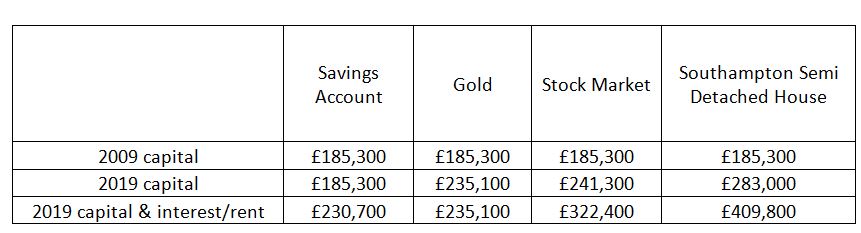
Let me start with the humble semi-detached house in Southampton ... which in 2009 was worth £185,300 … so assuming I bought that property for that figure, then I looked at what if I had invested the same amount of money in a building society, into gold and finally the stock market…

Putting your money into the stock market (FTSE100) would have brought a return of 30.2% on your capital over those 10 years and an average of 3.79% a year in dividends (making an overall increase of 74%).

Gold doesn’t earn interest – yet it has increased in value by 26.9% over the same 10 years whilst putting your money in the building society, the money hasn’t increased in value, but would have earned you interest of 24.46% or the equivalent of 2.21% per year.

Investing in an average semi-detached house in Southampton over the last 10 years has seen the capital increase by 53% (an equivalent of 4.34% per annum) and the income (i.e. the rent) has provided a return, based on the original purchase price, of 121.15% or the annual equivalent of 8.26% … meaning the overall return, based on the original purchase price of an average semi-detached property in Southampton, is 12.6% per annum.


Notwithstanding No.11 Downing Street’s grab at the profits of buy to let landlords by hitting the buy to let sector with several fiscal punishments with a 3% stamp duty level, a decrease in high rate tax relief for landlords and an increase in rate of CGT on residential property profits, the facts remain that ‘bricks and mortar’ is still one of the preeminent and most constant investments available.

The bottom line is, the buy to let investment remains the mainstay of the British property market, serving to support aspiring homeowners as they work to conquer the, sometimes difficult, financial obstacles of home ownership. With Central Government over the last 30 years only paying lip service to address the lack of new homes being built or tackling the affordability on a consequential scale, it is highly probable this will continue for the next 5/10/15 years as there will always be a call for a respectable, and above all, honest buy to let landlords delivering decent housing to those that need it.

If you would like to pick my brains on the Southampton Property Market – pop in for a coffee or drop me a line on social media or email. 

If you are looking for an agent that is well establishedprofessional and communicative, then contact us to find out how we can get the best out of your investment property.

Email me on brian.linehan@belvoir.co.uk or call on 023 8001 8222.

Don't forget to visit the links below to view back dated deals and Southampton Property News.


Friday, 3 May 2019

Which Southampton Properties are Selling the Best?


Moving home is said to be the third most stressful life event, following a member of your family dying or getting divorced. So it is always best to keep your stress levels down by investigating and doing your homework on both the particular area of Southampton (or nearby conurbations) where you live (i.e. where you are selling) and where you want to search for your next Southampton home. Being mindful of how fast (or slow) the different aspects of the Southampton property market is moving is key.. because it could save you much heartache and many thousands of pounds.

You see, if you know you are selling a property in a sluggish price range and buying in a faster moving price range in Southampton then putting your property on the market first is vital, otherwise you will always find the one you want to buy tends to sell before your property sells - there is nothing worse than pondering over a property only to find that someone else has bought it. Being primed with all the knowledge is key. On the other side of the coin, if you are selling in a fast moving market and buying in a sluggish market .. you can probably get a better deal on the one you are buying.

For buy to let landlords in Southampton, this evidence is particularly critical as purchasing a high-demand property in a well-liked area of Southampton will safeguard a surfeit of availability of tenants, as well as respectable house price growth. 
Being an agent in Southampton, I like to keep an eye on the Southampton property market on a daily basis because it enables me to give the best advice and opinion on what (or not) to buy in Southampton; be that a buy to let property for a landlord or an owner occupier house.  So, I thought, how could I scientifically split the Southampton housing market into sections, so I could analyse which part of the Southampton property market was doing the best (or the worst).

I took the decision that the preeminent way was to fragment the Southampton property market into roughly four uniform size price bands (in terms of properties for sale). Each price band would have roughly around 25% of the property in Southampton available for sale .. then add up all the sold (stc) properties and see which sector of the Southampton property market was performing best? … And these were the results ..


The best performing price range in Southampton is the lower market up to £180,000 where 46.2% of all property in that price range has a buyer and is sold stc.

It’s not unexpected that the upper end of the property market (the top 25%) in Southampton is finding things a little tougher compared to the others. Even though the number of first time buyers in 2018 did increase over the 2017 levels, it was from a low starting point and the large majority of 20 to 30yo’s don’t want to or can’t buy their first home and the local authority has no money to build Council houses meaning an increase in demand as private landlords take up the slack – because everyone needs a roof over their head!


If you would like to pick my brains on the Southampton Property Market – pop in for a coffee or drop me a line on social media or email. 

If you are looking for an agent that is well establishedprofessional and communicative, then contact us to find out how we can get the best out of your investment property.

Email me on brian.linehan@belvoir.co.uk or call on 023 8001 8222.

Don't forget to visit the links below to view back dated deals and Southampton Property News.

Friday, 26 April 2019

What Has Happened to the Southampton Property Market Since the Last Property Market Crash?


A handful of Southampton landlords and homeowners have been asking me what would happen if we had another property crash like we did in 2008/9?

The UK property crash in 2008/9 caused property prices in the UK to drop by an average of 18.37% in a period of 16 months.

On the run up to the Parliamentary vote on Brexit, a number of people asked what a no-deal Brexit would do to the property market and if there would be a crash as a result. I have discussed in a previous article on the chances of that (slim but always a possibility) … but assuming it happens, it is my opinion the outcome of a no-deal Brexit would be no worse than the country’s 2008/9 credit crunch property crash, the late 1988 property crash, the 1974 property crash, 1951 property crash … I could go on. The British economy would bounce back from the shock of a no-deal Brexit with lower property values and a continued low interest rate environment (together with an additional round of Quantitative Easing) and that would mean we would see a similar bounce back as savvy buyers saw it as a fantastic buying opportunity.

So, let me explain the reasons I believe this...

Many said after the Brexit vote in June 2016, we were due a property crash - but we all know what happened afterwards.

Initially, let’s see what would happen if we did have a crash, how quickly it would bounce back and then finally discuss how the chances of a crash are actually quite minimal.

Therefore, to start, I have initially split down the types of property in Southampton (Det/Semi etc.) and in the red column put the average value of that Southampton property type in 2009. Next in the orange column what those average values are today in 2019.


Now, assuming we had a property crash like we did in 2008, when average property values dropped nationally by 18.37%, I applied a similar drop to the current 2019 Southampton figures (i.e. the green column) to see what would happen to property values by the middle 2020 (because the last crash only took 13/14 months).

…and finally, what would subsequently happen to those same property prices if we had a repeat of the 2009 to 2014 property market bounce back.


Of course, these are all assumptions and we can’t factor in such things as China going pop on all its debt ... yet either way, the chance of such a crash coming from internal UK factors are much slimmer than in another of the four property crashes we have experienced in the last 80 years. Why, you might ask?

The seven reasons I believe are these …

1.      The new Bank of England mortgage rules on lending in 2014 to address reckless lending that fuelled that last crash.
2.      Low inflation.
3.      Low mortgage rates (the average Brit’s fixed rate mortgage is currently 2.26% and the variable rate mortgage of 3.07%).
4.      Wage rises are forecast to continue to outgrow inflation.
5.      Unemployment figures dropping to 4% (down from 8.4% in 2011).
6.      The high percentage (67.7%) of all British mortgages being on a fixed rate.
7.      And notwithstanding the distractions of Brexit over the last few years, it cannot be denied that the British economy has slowly and steadily been heading in the right direction for a number of years, built on some decent foundations of a steady housing market (unlike the 1988 and 2008 crashes when the housing market got overheated very quickly on the run up to the crashes).

So as the circumstances are much different to the last two crashes, the chances of a crash are much slimmer. Yet if we do have a crash, for the very same 7 reasons above why the chances of a crash are unlikely, those 7 reasons would definitely contribute to making the ensuing recession neither too long nor substantial in scale.

One final thought for the homeowners of Southampton. Most people when they move home, move up market, meaning in a decreasing market you will actually be the winner, as a 10% drop on yours would be much smaller in £notes than a 10% drop on a bigger property ... think about it.

One final thought for the new and existing buy to let landlords of Southampton. Well, the questions I seem to be asked on an almost daily basis by landlords are: -

·         “Should I sell my property in Southampton?”
·         “Is the time right to buy another buy to let property in Southampton and if not Southampton, where?”
·         “Are there any property bargains out there in Southampton to be had?”


Many other Southampton landlords, who are with us and many who are with other Southampton letting agents, all like to pop in for a coffee, pick up the phone or email us to discuss the Southampton property market, how Southampton compares with its closest rivals (Eastleigh, Winchester and Portsmouth), and hopefully answer the three questions above. I don’t bite, I don’t do hard sell, I will just give you my honest and straight-talking opinion. I look forward to hearing from you.

If you are looking for an agent that is well establishedprofessional and communicative, then contact us to find out how we can get the best out of your investment property.

Email me on brian.linehan@belvoir.co.uk or call on 023 8001 8222.

Don't forget to visit the links below to view back dated deals and Southampton Property News.