Search This Blog

Wednesday, 4 April 2018

1,576 First Timer Buyers in Southampton Bought Their First Home in 2017

A little bit of good news this week on the Southampton Property Market as recently released data shows that the number of first time buyers taking out their first mortgage in 2017 increased more than in any other year since the global financial crisis in 2009. The data shows there were 1,576 first time buyers in Southampton, the largest number since 2006.

I expect in 2018 that this increase of first time buyers will level out and maybe dip slightly as, nationally, figures demonstrate that first time buyer’s average household income was £40,691 and this represented 17.3% of their take home pay. Although, it might surprise readers that it is actually cheaper to buy than it is to rent at the ‘starter home’ end of the housing market. Many of you can remember mortgage rates at 12% ... even 15%. Today, at the time of writing this article, I found on the open market, 189 first time buyer mortgages at 95% (meaning only a 5% deposit was required) with 3 year fixed rates from a reputable High Street bank at 2.49% ... they even did a 3 year fixed rate 100% mortgage for 2.89%!

Interestingly, looking at the other end of the market, the buy-to-let investment in Southampton was subdued, with only 323 buy-to-let properties being purchased with a mortgage. However, I must stress, whilst there is no hard and fast data on the total numbers of landlords buying buy-to-let, as HM Treasury believes only 30% to 40% of buy-to-let property is bought with a mortgage. This means there would have been further cash only buy-to-let purchases in Southampton – it’s just that the data isn’t available at such a granular level.

In terms of the level of mortgage debt in Southampton, looking specifically at the SO14 to SO19 postcodes, you can see there has been a steady rise in borrowing over the last few years.
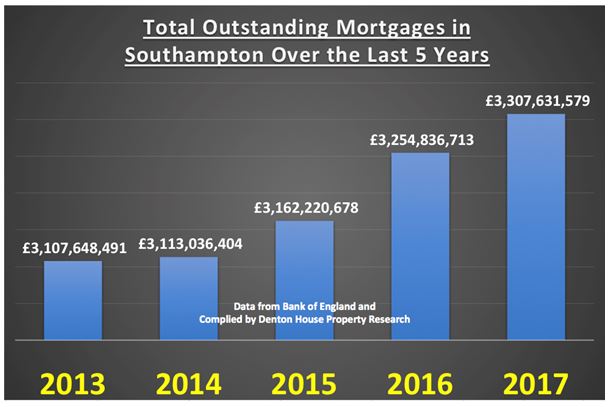

This is pleasing to see, as new mortgage debt is created by first time buyers, buy-to-let landlords and home movers themselves, that is being roughly equalled by the amount being paid off by mature mortgaged homeowners in their 50’s and 60’s eventually getting to pay off their mortgage.

So, what does all this mean for the Southampton Property Market?  Well, the stats do paint a picture, but they don’t inform us of the whole story. The upper end of the Southampton property market has been weighed down by the indecision around the Brexit negotiations and the rise in stamp duty in 2014, which made it considerably more expensive to buy a home costing more than £1m. The middle part of the Southampton property market has been affected by issues of mortgage affordability and lack of good properties to buy, as selling prices have reached the limit of what buyers can afford under existing mortgage regulations. The lower to middle Southampton property market was hit by tax changes for buy-to-let landlords, although this has been offset by the increase in first time buyers.

If you are in the market and selling now and want to ensure you get your Southampton property sold, the bottom line is you have to be 100% realistic with your pricing from day one and you might not get as much as you did say a year ago (but the one you want to buy will be less – swings and roundabouts?). I know it’s not comfortable hearing that your Southampton home isn’t worth as much as you thought, but Southampton buyers are now unbelievably discerning.


So, if you are thinking of selling your Southampton property in the coming months, don’t ask the agent out a few days before you want to put the property on the market, get them out now and ask them what you need to do to ensure you get maximum value in the shortest possible time. I, like most Southampton agents, will freely give that advice to you at no cost or commitment to you.

If you are looking for an agent that is well established, professional andcommunicative, then contact us to find out how we can get the best out of your investment property.

Email me on brian.linehan@belvoirlettings.com or call on 023 8001 8222.

Don't forget to visit the links below to view back dated deals and Southampton Property News.

Wednesday, 28 March 2018

An extension could add £58,525 to the value of your Southampton home


As our families grow bigger the need for more space, be that bedrooms or reception rooms, has grown with it. Also, as our older generation live longer and nursing home bills continue to rise quicker than a rocket on the 5th of November  (the average nursing home bill in the area being £715 per week) many families are bringing two households into one larger one.

So, should you move somewhere larger, or extend your Southampton property to make it large enough for you and your family? In some circumstances the choice has been made for you. If you live in an apartment with no garden, there isn’t much of an opportunity of making it larger. But if you have a house with a garden or an attic with sufficient headroom, extending your home becomes a real prospect.

Even if it makes more sense to extend or move, the choice hangs on a number of different dynamics – your future plans, money (both saved and access to finance), in what way you are emotionally attached to your home, the particular area of Southampton you live in and finally, the type/style of house you prefer.

Interestingly, the average British home is 968 sq.ft, which as you can see from the table, is in the middle of developed nations when it comes to the size of a property. Of the 1.11m homes sold in 2016 in England and Wales, the average floor area of the houses was 1,119 sq.ft – that’s about an eighth the size of an Olympic sized swimming pool. Apartments averaged 530 sq.ft that’s just over ten times bigger than an average garden shed. Looking at apartments and houses together, the average size of properties sold in England and Wales 968 sq.ft  – are slightly smaller than the European average, and much smaller than households in the US. 


So back to the question in hand.. extending does mean you will have a lot of inconvenience whilst the work is being carried out. The location of your Southampton property, the quality of construction, what type of room(s) you want to add, your plot, neighbouring building lines, planning regulations and the overall demand for your type of Southampton home, will make a vast difference to the financial repercussions of extending versus moving.

A medium-sized 270 sq.ft single storey extension (say around 17ft x 16ft) will add on average £58,525 to the value of a property in Southampton

It’s important to note the end result of the extension needs to be a sensible and realistic home. A two bed semi-detached house extended to a four bedrooms with no lawn or driveway, or a home with outsized reception rooms downstairs and miniscule bedrooms upstairs, could be problematic if  and when you come to sell your home in the future. Irrespective of whether your strategy is to live in your extended home for a long time, you will want to side-step outlaying a lot of money on costly building work that will make it tougher to sell.

In terms of what it would cost to build an extension, you can expect to pay on average between £140 to £200 per sq.ft, depending whether the extension is a single or double storey extension and other factors including finish and type of extension (note – I have seen it cost a lot more than these figures – so please speak with a builder) … So taking a mid line figure, that same 270 sq.ft extension on your Southampton home would cost on average £55,080.

However, moving means there are substantial costs incurred - Estate Agency fees, Removal Van, Survey Fees, Legal fees and Stamp Duty on the property you are buying. Neither option is the obvious choice and comparing the costs of extending your Southampton home to that of moving is not a stress-free undertaking.

How realistic each option is will probably come down to one thing .. your mortgage provider. You will need a considerable sum of equity in your Southampton home before you can think of increasing your mortgage more, because most lenders will require you to have at least 10% to 20% equity left in your property after the extension or move has been done.


The best advice I can give .. don’t assume anything …. get advice and opinion from builders, mortgage brokers, architects, mortgage people and of course… an agent. Look at your options and make an educated decision with all the superficial and objective facts in front of you.

If you are looking for an agent that is well established, professional andcommunicative, then contact us to find out how we can get the best out of your investment property.

Email me on brian.linehan@belvoirlettings.com or call on 023 8001 8222.

Don't forget to visit the links below to view back dated deals and Southampton Property News.

Wednesday, 21 March 2018

Southampton Property Market – The 13.8% ‘New Build Premium’

According to the National House Building Council (NHBC), more than 26,142 new homes were registered to be built in the South East last year, on par with 2016 levels of 26,147 dwellings. Great news when you consider it is one of the highest number of new builds in the region since the pre-recession levels of the Credit Crunch and the uncertainty of Brexit and the General Election.
So, when a landlord recently asked me why the brand-new property she was considering buying was a lot more expensive compared to a second-hand/existing property of similar type, accommodation, location and structure I thought this would make a fascinating topic to do some homework on … homework I want to share with the homeowners and landlords of Southampton.
You might believe that the difference between purchasing a new build home against purchasing a second-hand/existing home is just individual preference. Some buyers/tenants like the ostentatious trendy modern feel of a new home, whilst others like a home that has stood the test of time.

So, what is the right answer? Well, I am going to be looking at some statistics that shows there is a real difference in the Southampton City Council area’s property market when it comes to new vs existing homes and the price paid. Looking at the average price paid for existing (second-hand) versus a brand new home since 1996, one can see from the graph it makes interesting reading.


On this second graph, one can see the percentage difference in average price paid between new and existing…
 
Yet possibly nothing is ever that easy, as there are issues with these statistics.
The overall average for the whole Southampton City Council area for the ‘new build premium’ (new build premium being the additional price a buyer pays for buying a new property compared to a second-hand one) over the last 21 years has been 13.8%. These statistics actually show that it is problematic to compare like with like because it is impossible to completely separate all the different factors of type, accommodation, location and structure etc.

One would have to have a mirror image second-hand Southampton home and a duplicate new build right next door to each other, then calculate out which Southampton house buyers or Southampton buy to let landlords would pay more for? Perhaps if everything was the same (all things being equal), there might not be any difference in what buyers would be prepared to pay… but then again, it’s like new cars versus cars that have a few hundred miles on the clock ... there is always a difference on the forecourt … because things are never wholly equal.
What I do know is that my statistics of the Southampton property market show that new build Southampton apartments are worth more to people than their second-hand equivalents, whilst the difference is negligible between new build Southampton detached houses and second-hand Southampton detached houses.

However, I believe the really important lesson in all these statistics is the fact that ‘new build premium’ for new-build versus buying a second-hand property increases in a buoyant market and reduces in a tougher market.  So, if you want to buy new and the only consideration is money … try buying in a tougher challenging property market.
If you are looking for an agent that is well established, professional andcommunicative, then contact us to find out how we can get the best out of your investment property.

Email me on brian.linehan@belvoirlettings.com or call on 023 8001 8222.

Don't forget to visit the links below to view back dated deals and Southampton Property News.

Wednesday, 14 March 2018

Southampton’s £810,092,640 “Rentirement” Property Market Time Bomb


Yes, I said ‘rentirement’, not retirement ... rentirement and it relates to the 2,471 (and growing) Southampton people, who don’t own their own Southampton home but rent their home, privately from a buy to let landlord and who are currently in their 50’s to mid-60’s.

The truth is that these Southampton people are prospectively soon to retire with little more than their state pension of £155.95 per week, probably with a small private pension of a couple of hundred pounds a month, meaning the average Southampton retiree can expect to retire on about £200 a week once they retire at 67.

The average rent in Southampton is £1,366 a month, so a lot of the retirement “income” will be taken up in rent, meaning the remainder will have to be paid for out their savings or the taxpayer will have to stump up the bill (and with life expectancy currently in the mid to late 80’s, that is quite a big bill …  a total of £810,092,640 over the next 20 years to be paid from the tenant’s savings or the taxpayers coffers to be precise!

You might say it’s not fair for Southampton tax payers to pick up the bill and that these mature Southampton renters should start saving thousands of pounds a year now to be able to afford their rent in retirement.  However, in many circumstances, the reason these people are privately renting in the first place is that they were never able to find the money for a mortgage deposit on their home in the first place, or didn’t earn enough to qualify for a mortgage …and now as they approach retirement with hope of a nice council bungalow, that hope is diminishing because of the council house sell off in the 1980’s!

For a change, the Southampton 30 to 40 somethings will be better off, as their parents are more likely to be homeowners and cascade their equity down the line when their parents pass away.  For example, that is what is happening in Europe where renting is common, the majority of people rent in their 20’s, 30’s and 40’s, but by the time they hit 50’s and 60’s (and retirement), they will invest the money they have inherited from their parents passing away and buy their own home.

So, what does this all mean for buy to let landlords in Southampton?
Have you noticed how the new homes builders don’t build bungalows anymore ... in fact some would said the ‘bungalow story’ is over.  The waning in the number of bungalows being built has more to do with supply than demand.  The fact is that for new homes builders there is more money in constructing houses than there is in constructing bungalows.  Bungalows are voracious when it comes to land they need as bungalow’s have a larger footprint for the same amount of square meterage as a two/three storey house due to the fact they are on one level instead of two or three.

That means, as demand will continue to rise for bungalows supply will remain the same.  We all know what happens when demand outs strips supply … prices (i.e. rents) for bungalows will inevitably go up. 
If you are looking for an agent that is well established, professional andcommunicative, then contact us to find out how we can get the best out of your investment property.

Email me on brian.linehan@belvoirlettings.com or call on 023 8001 8222.

Don't forget to visit the links below to view back dated deals and Southampton Property News.

Wednesday, 7 March 2018

Southampton Private Rents Hit £21.38 per sq. foot


As I am sure you are aware, one the best things about my job as an agent is helping Southampton landlords with their strategic portfolio management. Gone are the days of making money by buying any old Southampton property to rent out or sell on. Nowadays, property investment is both an art and science. The art is your gut reaction to a property, but with the power of the internet and the way the Southampton property market has gone in the last 11 years, science must also play its part on a property’s future viability for investment.

Many metrics most property professionals (including myself) use when deciding the viability of a rental property is what properties are selling for, the average rent, the yield and an average value per square foot.

However, another metric I like to use is the average rent per square foot. The reason being is that it is a great way to judge a property from the point of view of the tenant ... what space they get for their money. Now of course, location has a huge influencing factor when it comes to rents (and hence rent per square foot). Like people buying a property, tenants also have that balancing act between better/worse location, more vs. less money and size of accommodation (bigger and more rooms equalling more money) and where they live (location) verses making ends meet.

Interestingly, I know there are a lot of you in Southampton who like to see my statistics on the Southampton property market, so before I talk about the rental figures per square foot, I wanted to share the £ per square foot on the values. In Southampton, the current AVERAGE figures are being achieved (and I must stress, these are average figures, so there will an enormous range in these figures), but on average, properties in Southampton, split down by type are achieving …

·         Southampton Detached Property - £332 / sq ft
·         Southampton Semi Detached Property - £295 / sq ft
·         Southampton Terraced Property - £291 / sq ft
·         Southampton Apartments - £293 / sq ft

So, to the rental figures:

The extent of space you get for your rent is replicated in the space you get for your money when buying a property. The average size of rental property in the Southampton area is 750.2 sq ft (interesting when compared to the national average of 792.1 sq ft)

This means the average rent per square foot currently being
achieved on a Southampton rental property is £21.38 per sq ft per annum

So, what we can deduce from this?  Well the devil is always in detail!

Whilst I was able to quote the average overall figure and the fact my research showed it was quite clear from data that there is relationship between the average £ per sq ft figures on property values and average £ per sq ft on rental figures as a property grows in size. However, something quite intriguing happens to those figures, in terms of what the property will sell for and what it will rent for, when we change and increase the size of the property.

My research showed that doubling the size of any Southampton property doesn’t mean you will double the value of it … in either value or rent. This is because the marginal value increases diminish as the size of the property increases. In layman’s terms … Subject to a few assumptions, doubling the size of the house doesn’t mean double the value … what really happens is a doubling of the size gives only an approximate 40% to 65% uplift in value, but here comes the even more fascinating part … when it came to the rental figures, double the size of the house meant only a 20% to 45% in increase in rent!


In a future article, I will be discussing the actual added value an extension can bring ... but in the meantime, in an overall and sweeping statement, most of the time it makes sense to extend if you are going to live in the property as long as the extension is proportionate to the property, but if you are going to rent it out ... possibly not.

If you are looking for an agent that is well established, professional andcommunicative, then contact us to find out how we can get the best out of your investment property.

Email me on brian.linehan@belvoirlettings.com or call on 023 8001 8222.

Don't forget to visit the links below to view back dated deals and Southampton Property News.

Wednesday, 28 February 2018

£714.02pm – The Profit made by every Southampton Property Owner over the last 20 years

As we go headlong into 2018, I believe UK interest rates will stay low, even with the additional 0.25% increase that is expected in May or June. That rise will add just over £20 to the typical £160,000 tracker mortgage, although with 57.1% of all borrowers on fixed rates, it will probably go undetected by most buy-to-let landlords and homeowners. I forecast that we won’t see any more interest rate rises due to the fragile nature of the British economy and the Brexit challenge. Even though mortgages will remain inexpensive, with retail price inflation outstripping salary rises, it will still very much feel like a heavy weight to some Southampton households.

Now it’s certain the Southampton housing market in 2017 was a little more subdued than 2016 and that will continue into 2018. Property ownership is a medium to long-term investment so looking at that long-term time frame; the average Southampton homeowner who bought their property 20 years ago has seen its value rise by more than 260%.
This is important, as house prices are a national obsession and tied into the health of the UK economy as a whole. The majority of that historic gain in Southampton property values has come from property market growth, although some of that will have been added by homeowners modernising, extending or developing their Southampton home.
Taking a look at the different property types in Southampton and the profit made by each type, it makes interesting reading..

Average Price
Paid in 1998 in Southampton
Average Price
Paid in 2018 in Southampton
Average Total Profit
in last 20 years in Southampton
Average Profit
per Month in Southampton over the last 20 years
 Detached
£115,675
£349,874
£234,199
£975.83
 Semi
£66,220
£258,888
£192,668
£802.78
 Terraced
£57,342
£224,500
£167,158
£696.49
Apartments
£46,849
£160,760
£113,911
£474.63
Overall Southampton Average
£66,130
£237,495
£171,365
£714.02


However, I want to put aside all that historic growth and profit and looking forward to what will happen in the future. I want to look at the factors that could affect future Southampton (and the Country’s) house price growth/profit; one important factor has to be the building of new homes both locally and in the country as a whole. This has picked up in 2017 with 217,350 homes coming on to the UK housing ladder in the last year (a 15% increase on the previous year’s figures of 189,690. However, Philip Hammond has set a target of 300,000 a year, so still plenty to go!

Another factor that will affect property prices is my prediction that the balance of power between Southampton buy-to-let landlords and Southampton first-time buyers should tip more towards the local first-time buyers in 2018.

The Council of Mortgage Lenders expects the number of buy to let mortgages to drop by 34% from levels seen in 2015. This is because of taxes being increased recently on buy-to-let and harder lending criteria for buy to let mortgages, which means I foresee a gradual move in the balance of power in favour of first-time buyers rather than buy-to-let landlords. First time buyers will also be helped by The Chancellor eradicating Stamp Duty for all properties up to £300,000 bought by first-time buyers in the recent budget.

This means Southampton buy-to-let landlords will have to work smarter in the future to continue to make decent returns (profits) from their Southampton buy-to-let investment. Even with the tempering of house price inflation in Southampton in 2017, most Southampton buy to let landlords (and homeowners) are still sitting on a copious amount of growth from previous years.
The question is, how do you, as a Southampton buy to let landlord ensure that continues?

Since the 1990’s, making money from investing in buy-to-let property was as easy as falling off a log. Looking forward though, with all the changes in the tax regime and balance of power, making those similar levels of return in the future won’t be as easy. Over the last ten years, I have seen the role of the forward thinking letting agents evolve from a ‘rent collector’ and basic property management to a more holistic role, or as I call it, ‘landlord portfolio strategic leadership’. Thankfully, along with myself, there are a handful of letting agents in Southampton whom I would consider exemplary at this landlord portfolio strategy where they can give you a balanced structured overview of your short, medium and long-term goals, in relation to your required return on investment, yield and capital growth requirements. If you would like such advice, speak with your current agent – or whether you are a landlord of ours or not – without any cost or commitment, feel free to drop me a line.
If you are looking for an agent that is well established, professional andcommunicative, then contact us to find out how we can get the best out of your investment property.

Email me on brian.linehan@belvoirlettings.com or call on 023 8001 8222.

Don't forget to visit the links below to view back dated deals and Southampton Property News.

Wednesday, 21 February 2018

With Southampton annual property values 4.4% higher, here is my 2018 forecast…


Looking at the newspapers between Christmas and New Year, it seemed that this year’s sport in the column inches was to predict the future of the British housing market. So following the same theme, here are my thoughts on the Southampton property market.
With the average 5-year fixed rate mortgage at 1.98% (down from 3.47% in 2014) and 2-year fixed rate at 1.47% (down from 2.37% in 2014), mortgage interest rates offered by lenders are at an all-time low, and that’s even with the slight increase on the Bank of England base rate a few months ago. Added to this, there has been a low unemployment rate of 4.7% in Southampton, which has contributed to maintaining a decent level of demand for property in Southampton in 2017. Interestingly, an impressive 5,328 Southampton properties were sold in last 12 months, whilst finally, the number of properties for sale in the city has remained limited, thus providing support for Southampton house prices, meaning…

Southampton property values are 4.4% higher than a year ago

However, as continue into 2018, there will be greater pressures on people’s incomes, as inflation starts to eat into real wage packet growth, which will in turn wield a snowballing strain on consumer confidence. Interestingly though, information from the website ‘Rightmove’ suggests that over a third of the properties it had on its books in October and November had their asking prices reduced - the highest percentage of asking price reductions in the same time frame[CA1] , for over five years. Still, a lot of that could have been house-sellers being overly optimistic with their initial pricing.

In terms of what will happen to Southampton property values in the next 12 months, a lot will be dependent upon the type of Brexit we have and the impact on the whole of the UK economy. A lot of people will talk about the Central London property market in the coming year, and if the banking and finance sectors are negatively affected with a poor Brexit deal, then the London market is likely to see more of an impact.

Nevertheless, Southampton homeowners and Southampton Landlords should be aware of what happens in the rollercoaster housing market of Central London, but not panic if prices there drop suddenly during 2018. Over the last 8 years the Central London property market has been in a world of its own (Central London house prices have grown by 89.6%, whilst in Southampton, they have only risen by 36.4%). So we might see a heavy correction in the Capital, whilst more locally, something a little more subdued.  

Hindsight is always easier than foresight and predicting anything economic is all well and good when you know what is around the corner. At least we have the Brexit divorce settlement sorted and, as the UK economy and the UK housing market are intertwined, it all depends on how the country deals with the Brexit issue. Having been through the global financial crisis and come out reasonably intact, I am sure we can get through this together as well!

Oh, and house prices in Southampton over the next 12 months? I believe they will end up between 0.2% and 1.5% higher, although it will probably be a bumpy ride to get to those sorts of figures.

If you would like to read more articles on my thoughts on the Southampton property Market – please visit the Southampton Property Market Blog

If you are looking for an agent that is well established, professional andcommunicative, then contact us to find out how we can get the best out of your investment property.

Email me on brian.linehan@belvoirlettings.com or call on 023 8001 8222.

Don't forget to visit the links below to view back dated deals and Southampton Property News.